Android now · iPhone soon · your own API key
A book about exactly your thing, at exactly your level.
MetaBook interviews you about a topic, proposes chapters you can edit, and writes the book on your phone, one chapter at a time. When a passage lands badly, hold it and say what is wrong with it.
$5 once on Google Play. Then your own OpenRouter key, at cost — about 25¢ for an eight-chapter book. No subscription.
Not sure yet? Read the sample book first.
No account, no server of ours, no analytics. Every model call goes from your phone to your provider, and says what it will cost before it runs.
The problem
Nobody has written the book you need.
A model will draft you a chapter about anything today. Turning that into a book you can sit down and read — on the right topic, at the right depth, in something that behaves like a reader — is the part nobody has done.
What it takes now
- Search for a book on exactly your topic.
- Settle for one that is half about it.
- Or ask a chatbot, one chapter at a time.
- Convert the answers to EPUB by hand.
- Get the file onto the phone.
- Read it in a separate e-reader.
- Hit a dense passage — copy, switch apps, ask.
Every step costs a file conversion or an app switch, so you stop asking for the book you wanted and read the one that exists.
What it takes here
- Say what you want a book about.
- Answer a few questions.
- Read.
- Hold a passage and say what is wrong with it.
One to three are the book, and they are most of the app. Four is what you do to it without ever leaving the page.
Before you pay
Read a whole book in it first.
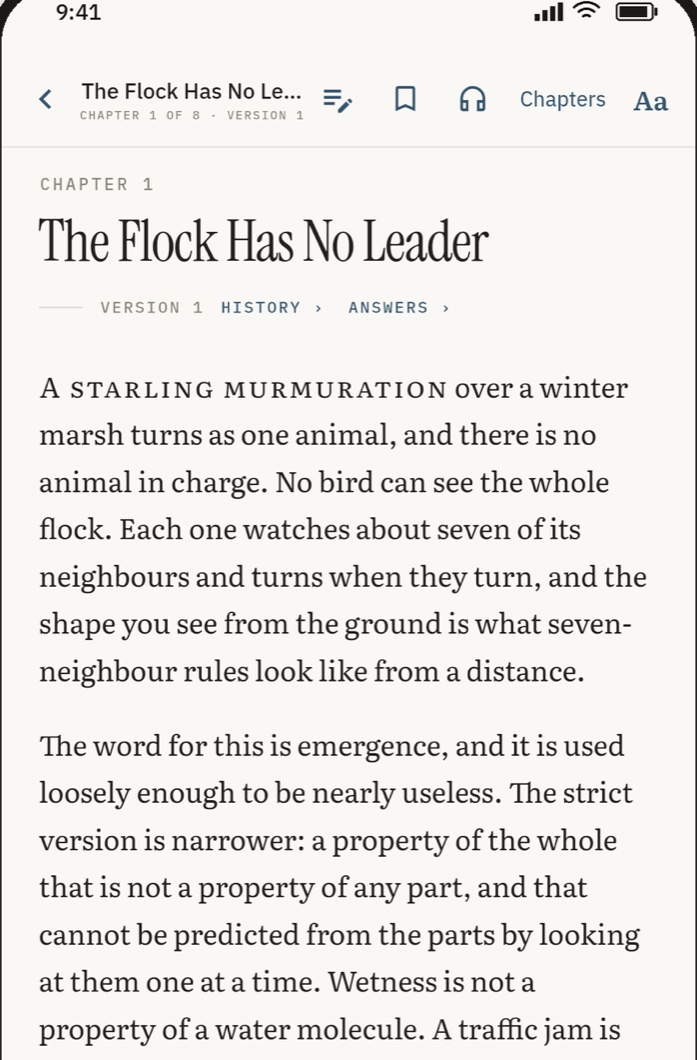
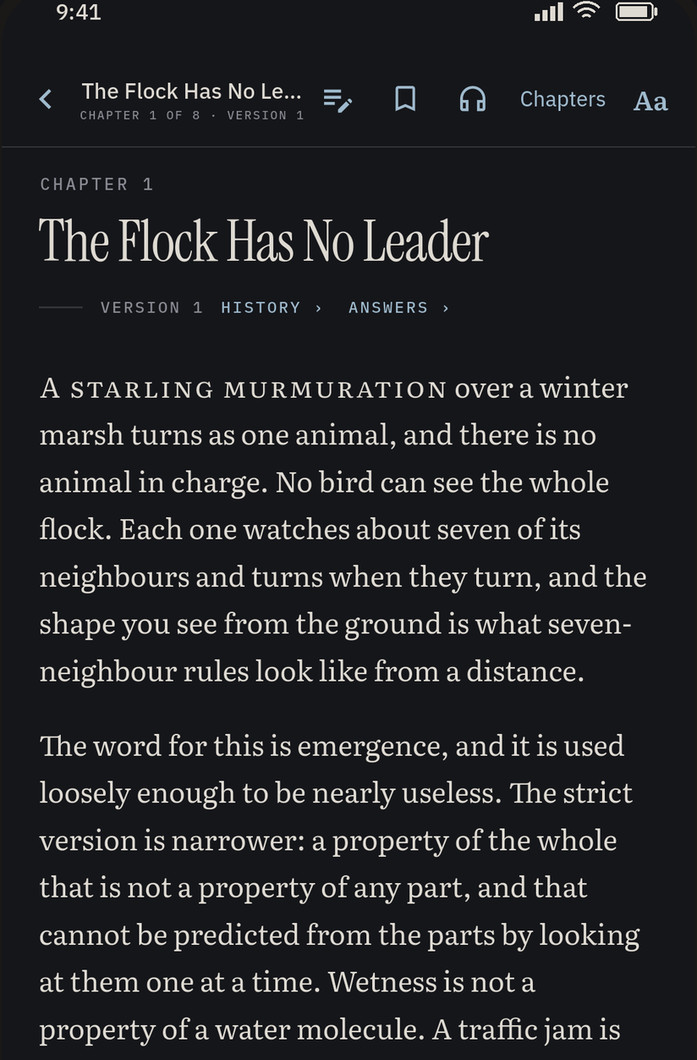
Every install comes with a book already on the shelf, so there is something to read before you have a key. Here is a whole one, laid out the way the app lays it out: three chapters, a formula, a table and a picture.
It is the shape every book takes — an outline you accepted, chapters written one at a time, and any paragraph rewritable in place. The ones you make are written by the model, to your brief.
While reading
Hold a passage. Say what is wrong with it.
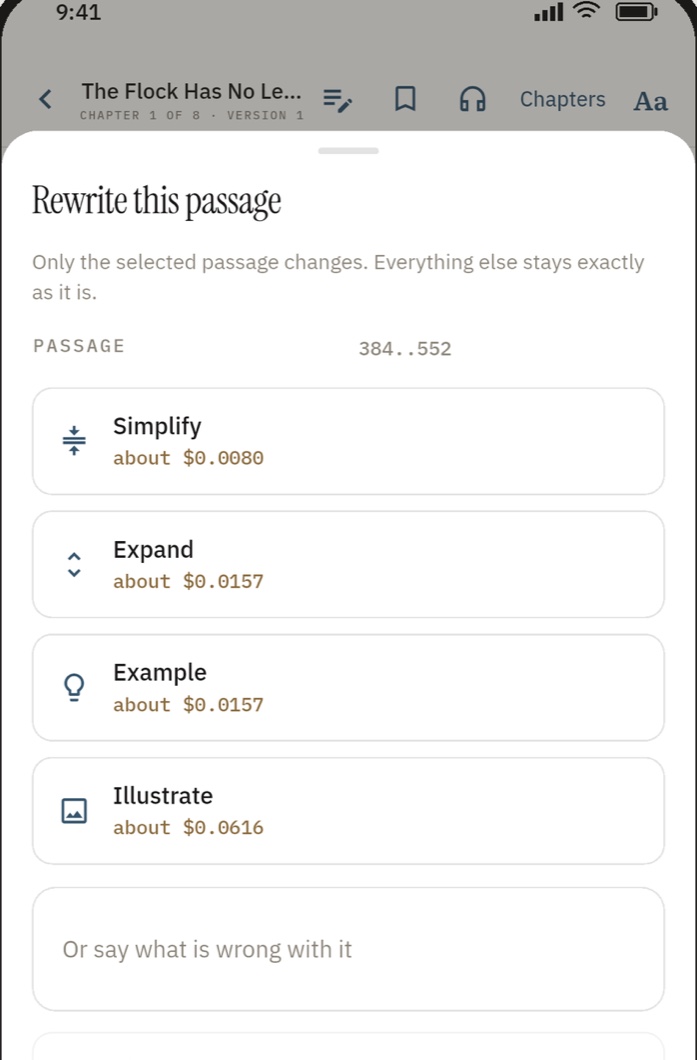
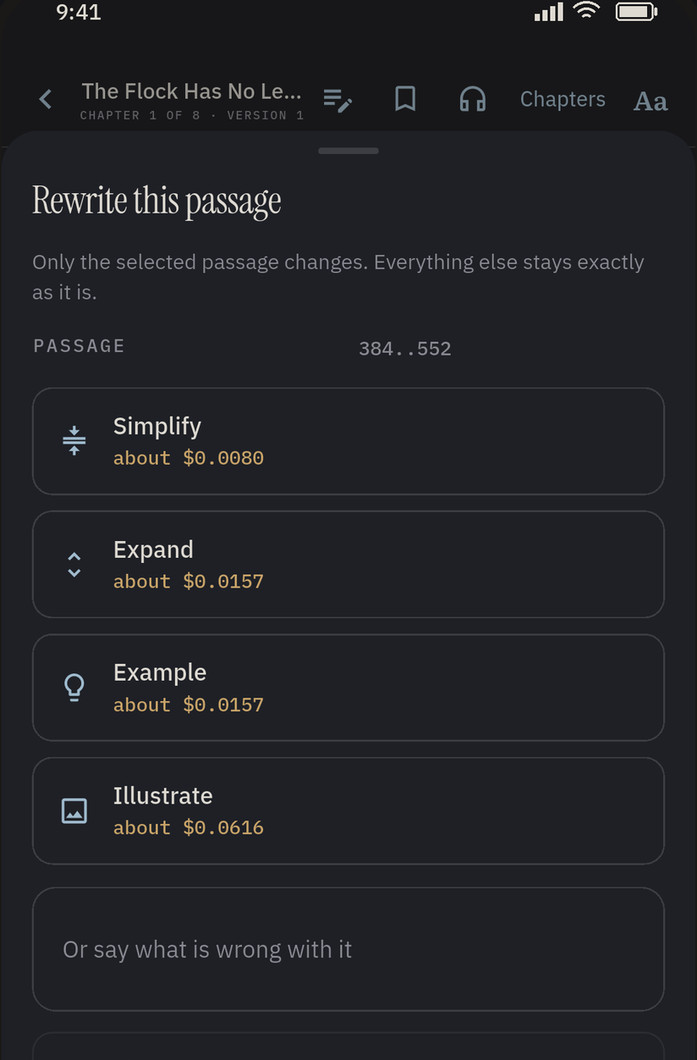
No brief survives contact with a paragraph that is too dense. So the second half of the app is one gesture: touch and hold any paragraph, and a toolbar appears — Rewrite, Ask, Edit and copy. Every paid action states its price on the control before you press it.
-
01
Simplify
Plainer words, in place. The cheapest and fastest call the app makes, because you run it while reading.
-
02
Expand
The same ground at greater length — for the paragraph that went past something you wanted more of.
-
03
Example
A short worked case, written into the book where the abstraction was.
-
04
Illustrate
A picture of what the passage describes, placed directly under it and kept in the book. Around 8¢.
-
05
Or say it in your own words
Say which years. Give this its own paragraph. This contradicts chapter two. One instruction per call, and only the passage changes.
Ask answers a question without touching the book and keeps the answer on the passage. Edit is by hand and costs nothing. Undo restores the previous text as a new version, so nothing is ever lost. What makes rewriting in place safe.
The reader in the brief does not have to be you. Answer the interview about somebody else — the new hire, a student, a parent and their new phone — read it through, and export them the EPUB. Writing for somebody else.
Setup
Three steps. About five minutes.
MetaBook has no server, so it cannot pay for your generation. You bring an OpenRouter account, and the app walks you into it.
-
1
Buy it on Google Play
$5, once. There is no subscription and nothing else to buy from us, ever.
-
2
Connect OpenRouter
The key screen asks one question: do you already have an OpenRouter key? Paste it if you do. If not, tap Connect, approve it in the browser, and the app is given a key of its own with its own limit. OpenRouter is one account in front of hundreds of models and it is the only provider the app talks to — a key from OpenAI or Anthropic will not work directly, but their models are on the menu.
-
3
Put a few dollars on it
Five dollars of credit is about twenty eight-chapter books on the default model. The app shows an estimate before every call, keeps a ledger on the phone, and stops at a daily cap you can move.
Without a key you can still open the app and read the sample book. Nothing new is written until a key is there.
Money & privacy
You are spending your own money, so the app never hides it.
Every call is billed to the provider account your key belongs to, at the provider's price, with nothing added by us. There is no server of ours in the path and no analytics anywhere in the app.
- An estimate before, a figure after. Anything that spends says what it will cost before it runs, and what it actually cost when it is done. Estimates are quoted high.
- A daily cap and a per-book budget, on by default. They refuse rather than warn. Raising one is a decision you make in Settings, deliberately, not mid-chapter.
- Every call writes a row. The ledger is on your device and it is yours to read: what the call was for, which model, what it cost.
- Your key lives in the phone's secure storage. Keychain on iOS, Keystore on Android. It never reaches a log, an export or a backup.
- Your text goes to your provider, and nowhere else. What you type and what your books hold leave the device only inside a model call addressed to OpenRouter.
- The library is one file on your phone. Back it up whole, restore it on another phone, or delete all of it, key included, in one action that says exactly what it removes.
Before you buy it
What it does not do.
- It needs an API key. MetaBook is $5 once and has no server, which means it cannot pay for your generation. You bring an OpenRouter account — connecting one takes a couple of taps — and the bill for model calls is yours. Without a key you can look around and read the sample book, but nothing new is written.
- The chapters are written by a language model, and checked by nobody. A model states wrong things as confidently as right ones. A book here is a good starting point and a bad citation.
- No fiction. This is for non-fiction and for learning. Novels are a different job and it does not do that job.
- Phones only. Android now, iPhone soon. There is no web version and no desktop one.
- No accounts, so no sync. Your library lives on one device. Moving it to another is a backup file you carry across yourself.
- A book you write for somebody else leaves as a file. Export it and they read it in whatever opens an EPUB. There is no way to hand somebody a book that is still live — the reading actions need the app, a key of their own, and the book on the device it was made on.

Ask for the book you wanted.
Then change it as you read.
$5 once on Google Play. What you spend after that is what your provider charges, and the app tells you before you spend it.
iPhone: coming soon. Leave an email and you get one message, the day it is on the App Store.
You are on the list. One email when it ships, then the address is deleted.
That did not go through — check the address and try again.