A book about the single chemical bond that half the food on earth had to get past, laid out here the way the app lays it out: three chapters, a formula, a table and a picture. In the app you would hold any paragraph of it and say what is wrong with it. What MetaBook does.
Every protein you are made of is built around nitrogen atoms. So is every strand of your DNA. And you are standing in it: the air is 78 per cent nitrogen, and an adult breathes something like eleven thousand litres of air a day, which carries several kilograms of the element in and straight back out again.
None of it is available to you. Not a single atom of the nitrogen you breathe ends up in you. Plants cannot take it either, and neither can anything else you eat. For almost all of life on earth, the atmosphere is a locked pantry.
The lock is one chemical bond.
The strongest bond in ordinary chemistry
Nitrogen in the air travels in pairs, as N₂, and the two atoms are held together by a triple bond — three shared pairs of electrons, pulled in tight. Prising them apart costs 945 kilojoules for every mole of gas, and that number is worth putting beside its neighbours:
Bond
Where you meet it
To break it, kJ/mol
N≡N
nitrogen in the air
945
O=O
oxygen in the air
498
H–H
hydrogen gas
436
N–H
ammonia, one bond at a time
391
C–C
most of the rest of you
348
Nothing else in everyday chemistry is close. Oxygen, which is reactive enough to rust a bridge and burn a forest, is held together by barely half as much. The triple bond is why nitrogen is the gas that does nothing: it is not that it has no use for company, it is that the cost of leaving its own is so high that almost nothing can pay it.
Two ways in, both expensive
Nature has exactly two routes past the lock, and both are extravagant.
The first is lightning. A stroke heats the air in its channel to something like 30,000 °C, which is enough to tear N₂ and O₂ apart together and let the fragments find each other as nitric oxide. Rain washes the result into the ground. It is a real supply and a small one.
The second is a bacterial enzyme called nitrogenase, which some microbes carry — including the ones living in nodules on the roots of peas, beans and clover. It does at ordinary temperature and pressure what the lightning does with brute heat, and it charges accordingly: roughly sixteen molecules of ATP, the cell's own currency, for each molecule of nitrogen it opens. Biology does very little else that costs so much, and it is still the cheapest route on the planet.
Why a field wears out
Every harvest carries nitrogen off the field inside the crop, and the field does not get it back by itself. Farmers have known the shape of this for as long as there has been farming, without knowing the chemistry: leave the land fallow, turn in manure, plant clover and plough it under. All three are ways of buying nitrogen from the only suppliers there were.
By the nineteenth century Europe had outgrown them. It bought instead: guano, scraped off Peruvian islands by indentured labourers, and then sodium nitrate dug out of the Atacama desert. Both were finite, both came from one part of the world, and one of them was worth a war. Chile, Peru and Bolivia fought over the nitrate fields from 1879 to 1884, and Bolivia lost its coastline for good.
In 1898 William Crookes stood up in front of the British Association and said the obvious thing out loud. The deposits would run out; the wheat would run short; and the way out, if there was one, was to take nitrogen from the air. He called it one of the great discoveries awaiting the ingenuity of chemists, which was a polite way of saying that nobody had the first idea how to do it.
The problem was now stated exactly. Above every exhausted field in Europe there sat, free and unguarded, a column of air containing more nitrogen than the field could use in a thousand years. All anyone had to do was open it.
Chapter 2
Fast, or Worth Having
The reaction was never the problem
Here is the reaction everybody wanted, written out: N₂ + 3H₂ ⇌ 2NH₃.
Nitrogen and hydrogen, making ammonia. And it is downhill. Making two moles of ammonia this way gives off about 92 kilojoules; the products sit lower than the ingredients, which is chemistry's way of saying the reaction would like to happen.
So mix the two gases in a flask and wait. Nothing occurs. Wait a year and nothing occurs. The reaction that would like to happen does not happen, and the reason is the first thing chemistry teaches that genuinely surprises people: whether a reaction can go and whether it will go in your lifetime are two different questions, settled by two different things.
The hill in the way
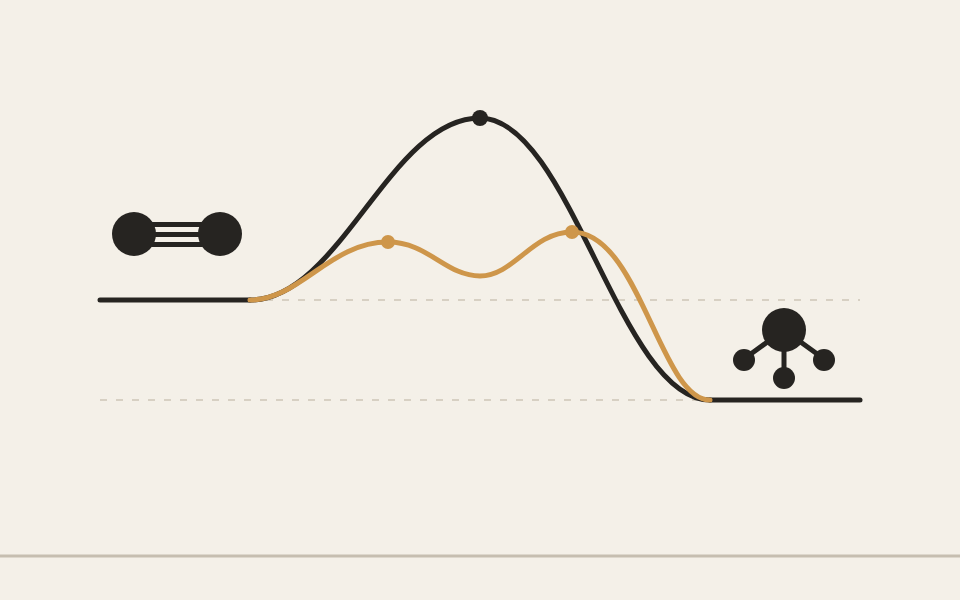
To get from nitrogen and hydrogen to ammonia, the molecules have to pass through an arrangement that is worse than either end — bonds half broken, nothing yet formed. That intermediate state sits at the top of a hill, and the height of the hill is called the activation energy. For nitrogen it is a very high hill, because getting over it means paying most of that 945 kilojoules up front.
the hill a reaction has to climb, and the lower pass a catalyst opens through it
How many molecules make it over is a matter of how hard they are being shaken, which is what temperature is. The relationship has a name and a shape:
k = A \exp(-E_a / RT)
The rate k does not rise gently with the temperature T; it rises exponentially, and the barrier sits up in the exponent with a minus sign in front of it. For a typical reaction, ten degrees of warming roughly doubles the rate. For one with a barrier as high as this, cold is not slow. Cold is nothing at all.
The trade nobody could win
The obvious fix is heat, and heat makes everything worse — not for the rate, but for the destination.
Ammonia sits at the right-hand end of a reversible arrow, and a reversible reaction settles at a balance point that the conditions decide. Two conditions move it here. Four molecules of gas go in and two come out, so squeezing the mixture favours the side that takes up less room: pressure pushes towards ammonia. And the reaction gives off heat, so warming it favours the side that puts the heat back: temperature pushes away from ammonia.
That is the trap in full. At 200 atmospheres and 350 °C the balance sits at about half ammonia — and at that temperature the mixture would take geological time to reach it. At 500 °C it gets there quickly, and there is under a fifth of it. Cool enough to be worth having, too slow to have. Hot enough to have, not worth having.
What a catalyst actually does
A catalyst does not move the balance point. It cannot: it does not change the energies of the ingredients or the products, and the balance is decided by those. Nor can it make an uphill reaction run. Anyone selling you either of those is selling something else.
What it changes is the route. On the surface of iron, nitrogen does not have to break its triple bond in one heroic act in mid-air. The molecule lands, sticks, and comes apart against the metal — the bond is prised open by the surface rather than snapped by a collision — and the loose atoms then meet hydrogen a bond at a time. Same starting materials, same destination, same balance point at the end. A different path between them, with a much lower pass through the hill.
And that is enough, because it changes which temperature you are allowed to use. With a route this cheap, 400 to 500 °C is hot enough to run at a sensible speed — a temperature at which the balance point still leaves you a usable fraction of ammonia. Squeeze the gas hard to claw some of that fraction back, take the ammonia out as it forms, and send everything unreacted round again.
Finding the surface took brute force. Alwin Mittasch and his colleagues at BASF worked through thousands of tests on thousands of substances — osmium and uranium both worked and neither could be had in quantity — before settling on iron, made from a particular magnetite ore, with a little potassium and alumina in it that does nothing itself except keep the iron from sintering shut. It is still iron today. A century of looking has not turned up anything much better.
Chapter 3
Half of You Came Through a Pipe
From a cupful an hour
In 1909 Fritz Haber had a bench apparatus the size of a table lamp that made ammonia at about a cupful an hour, and that was the easy part finished. Turning it into tonnes was handed to Carl Bosch at BASF, and it is the part that deserves the second name on the process.
Nobody had built anything to hold a gas at two hundred atmospheres and five hundred degrees, and the first vessels that tried it burst. Not from the pressure — from the hydrogen. Hot hydrogen at that pressure works its way into steel and attacks the carbon that makes it steel, turning it out as methane and leaving cracks behind. The metal is quietly eaten from the inside and then fails all at once.
Bosch's answer was to stop trying to keep hydrogen out. The reactor got two walls: an inner liner of soft low-carbon iron with almost nothing in it for hydrogen to attack, and an outer shell that took the pressure — drilled through with small holes, so that any hydrogen which had worked its way through the liner could hiss out to the air instead of collecting in the wall. The first plant opened at Oppau in 1913 and the chemistry has not changed since. Almost everything else about it has.
The bill, in energy
Ammonia is now made at something like 180 million tonnes a year, and the process consumes on the order of one to two per cent of all the energy used by everyone on earth. Put that way it sounds like a rounding error. Put the other way — a single reaction, in a few thousand plants, accounting for a hundredth of human energy use — it is one of the largest deliberate things our species does.
Most of that energy is not spent on the nitrogen. It is spent on the hydrogen. There is no hydrogen lying about to be collected, so it is stripped out of natural gas with steam, which leaves the carbon behind as carbon dioxide. The nitrogen half of the reaction is free and always was; the hydrogen half is where the fossil fuel and most of the emissions sit.
What it bought, and what it cost
It bought food. The honest estimate, and it is Vaclav Smil's, is that about half the nitrogen atoms in the proteins of a person alive today were fixed in a steel reactor rather than by a bacterium. Roughly half the world eats because of this reaction. There is no other single piece of chemistry that can be said about.
It also bought explosives. Ammonia goes to nitric acid in one further step, and nitric acid goes to munitions. Germany entered the First World War cut off from Chilean nitrate and did not run out of shells, because it no longer needed anyone's permission to make them. Haber spent the same war directing Germany's chemical weapons programme in person, and was given the Nobel Prize for chemistry a year after it ended. Both facts are about the same man and the same reaction.
And it leaks. Less than half of the nitrogen put on a field ends up in the crop. The rest moves: into groundwater as nitrate, into rivers and out to sea, where it feeds algae that bloom, die, and take the oxygen with them as they rot — the dead zones that appear off river mouths every summer. Some leaves as nitrous oxide, which is a greenhouse gas with about 270 times the warming effect of carbon dioxide, molecule for molecule, and which also thins the ozone layer. One atom, once fixed, can do harm several times over on its way back to the air.
What is being tried
Better aim. Splitting the dose, timing it to the plant, keeping legumes in the rotation. Unglamorous, available now, and the largest near-term saving.
Green hydrogen. The same reactor, the same iron, but hydrogen from water and electricity instead of methane. It removes the carbon and not the energy.
Doing it cold. Electrochemical routes that reduce nitrogen at ordinary temperature, or nitrogenase genes engineered into cereals. Both would be transformative and neither works yet at any useful rate.
Every one of them has to deal with the same number this book started with. The bond is still 945 kilojoules a mole. Nothing that has been tried has made it cheaper — only found a different way to pay, and a different place to send the bill.
That was the sample. Yours starts with the interview.
$5 once on Google Play, then your own OpenRouter key at cost — about 25¢ for an eight-chapter book.